
The Physical + Digital Stack

The AI buildout is a layered system spanning raw materials, compute infrastructure, and cloud and software platforms.

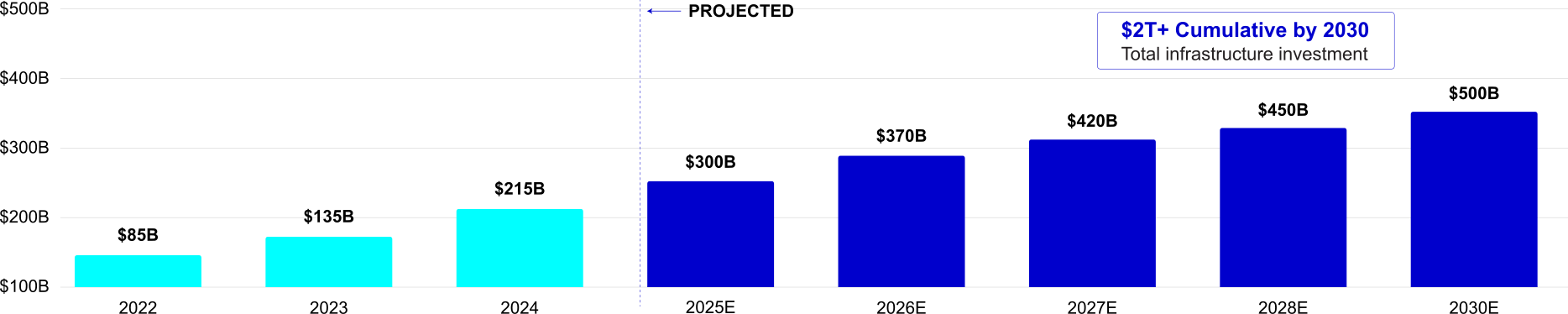
Projected AI infrastructure investment graph

Layer 01–02: Inputs and Chips

Critical minerals, rare earths, silicon, and advanced semiconductors form the upstream base of the AI economy.

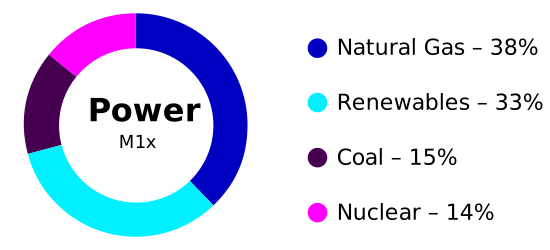
AI data center power sources chart

Layer 03–06: Physical Infrastructure

Server racks, cooling systems, power supply, and hyperscale data centers absorb the bulk of near-term capital.

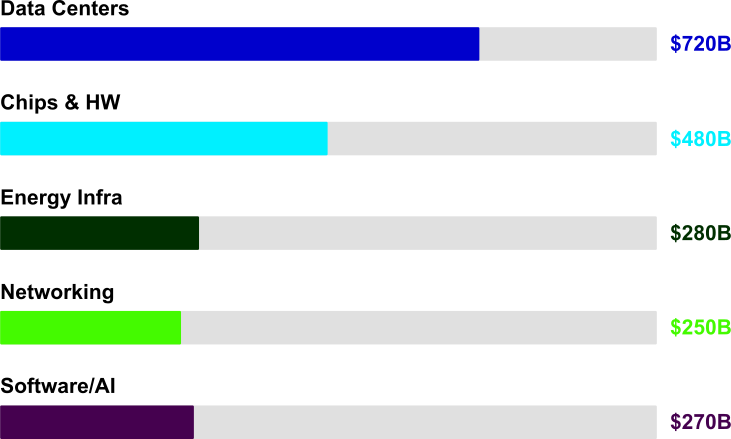
AI capital concentration chart

Layer 07–08: Network and Software

High-speed interconnects, cloud platforms, foundation models, and AI applications sit at the top of the stack.

The upstream bottlenecks are strategic: the U.S. imports over 90% of many critical minerals, TSMC fabricates roughly 90% of advanced AI chips, and GPU-dense infrastructure is driving a buildout that stretches from mines and fabs to cooling plants and utility-scale power procurement.

Where the $2T is going

Near-term AI spending is concentrating in compute, facilities, cooling, and energy rather than only in applications.

Investment is following a classic picks-and-shovels pattern. Dense GPU racks can draw roughly 100 kW each, cooling can consume 30 to 40% of data center capital expenditure, and interconnection queues in many U.S. regions already carry five- to seven-year backlogs. That is why server hardware, energy infrastructure, and data center campuses remain the immediate capital sink.

Federal incentives accelerating the buildout

AI infrastructure is being supported by incentives across research, energy efficiency, and clean power.

The source page highlights three major levers: the R&D Tax Credit for builders and innovators improving products or processes, Section 179D for high-efficiency facilities such as advanced data centers, and the ITC under Section 48 and the IRA for solar, storage, wind, fuel cells, and other clean energy assets that can support AI-scale power demand.

Key signals from the AI buildout

Industrial AI investment article visual
Signal 1

Semiconductor concentration remains a structural risk

TSMC fabricates roughly 90% of advanced AI chips, while NVIDIA continues to dominate the training market. That concentration makes fabrication access, packaging capacity, and geopolitical resilience central to AI strategy.

AI power mix chart
Signal 2

Cooling and energy are now first-order constraints

Traditional air cooling tops out far below dense GPU requirements, so direct liquid cooling, immersion systems, and power procurement have become strategic design decisions rather than facility afterthoughts.

AI capital concentration chart
Signal 3

The physical stack is the near-term capital sink

The software layer may capture outsized long-term revenue, but the immediate wave of spending is landing in fabs, racks, cooling plants, campuses, grid access, and transmission-ready energy projects.

At a glance

AI infrastructure background graphic

Capital concentration

Illustrative allocation of more than $2T through 2030.

$200B+ was committed to new U.S. data center projects in 2024 alone, while the global data center market is projected to reach $1.3T by 2030. The pace of AI demand is pushing every adjacent infrastructure layer harder at the same time.

The same momentum is reshaping energy markets as hyperscalers pursue solar, wind, storage, and nuclear supply to support round-the-clock AI operations and reduce exposure to grid bottlenecks.